
Audible Continuity Tester
A tester that sounds when there is continuity between its two leads. Use it to check wires, fuses, switches and tracks, always with no power on them.
Bill of materials
Everything you need to build it, with the reference you will see on the schematic.
| Qty | Part | Ref. |
|---|---|---|
| 1 | 1 kΩ resistor (brown-black-red) | R1 |
| 1 | Two test leads with wire | PR1 |
| 1 | BC547 NPN transistor | Q1 |
| 1 | Active buzzer (3 to 24 V) | BZ1 |
| 1 | 9 V battery with snap clip | BT1 |
| 1 | Breadboard (400 tie-points or more) | |
| 4 | Jumper wires |
Missing parts? The kits recommended by Impeca Tech include almost all of them. See the kits
Schematic & wiring
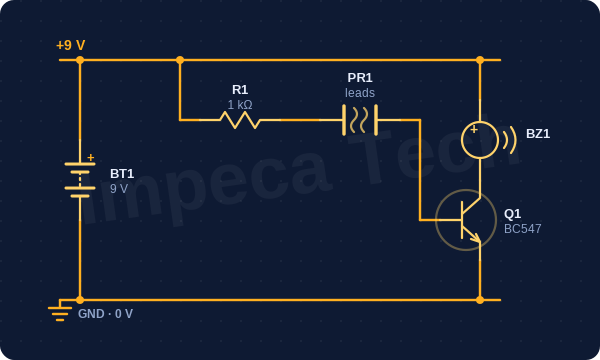
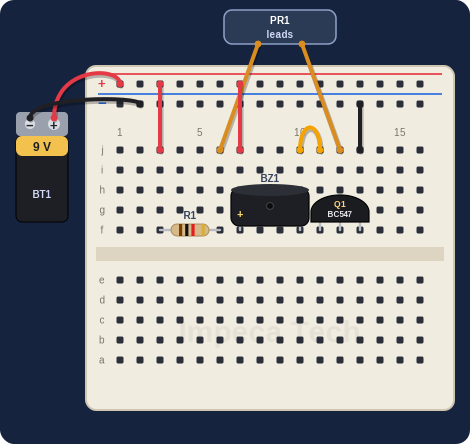
On the left, the circuit diagram; on the right, the same circuit built on a breadboard. Both connect exactly the same things.
Wire it step by step
-
Place the components
- 1 kΩ resistor R1 (bands: brown, black, red, gold): one leg in 3f and the other in 6f (either way round).
- BC547 transistor Q1 with the flat face (the one with the text) towards you, left to right: collector (C) in 11f, base (B) in 12f, emitter (E) in 13f.
- Active buzzer BZ1: the long leg (marked +) in 7f and the other leg in 10f. Reversed, it will not sound.
-
Add the jumper wires
- Red wire: from 3j to the + (red) rail.
- Red wire: from 7j to the + (red) rail.
- Orange wire: from 10j to 11j.
- Black wire: from 13j to the − (blue) rail.
-
Connect the probe
- Two test leads with wire (PR1): one wire to 6j and the other wire to 12j.
-
Connect the battery
- Connect the 9 V battery to its clip: the clip’s red lead to the + (red) rail and the black one to the − (blue) rail. Do this last, once everything else is in place.
-
Test the circuit
- Touch the two leads together: it should sound. Part them: it stops. Try a good wire (sounds), a healthy glass fuse (sounds), a 10 kΩ resistor (sounds) and a scrap of paper or plastic (does not sound). A wire broken inside does not sound: that is how you find broken cables.
How to read the holes: the letter is the row and the number is the column of the breadboard (for example 7f). The red (+) and blue (−) rails are the two long lines along the edge.
How does it work?
- 1You touch the wire or part with both leads
- 2If it conducts, current flows from the battery
- 3R1 feeds it to the base of Q1
- 4The buzzer sounds
R1 (1 kΩ) and the two leads form a path from the battery plus to the base of Q1. With the leads in the air the circuit is open and silent. Joined by a wire (under 1 Ω), about 8 mA flows to the base, Q1 saturates and the active buzzer gets about 28 mA. It keeps sounding at full strength if a resistance of tens of kΩ sits between the leads (10 kΩ or 47 kΩ in the simulation) and falls silent with 10 MΩ, almost an insulator: the buzzer then gets about 0.3 mA and does not sound. It is a yes/no test of conduction, not a resistance meter. Use it only on parts with no power: never connect it to the mains or to a powered circuit.
Testing & troubleshooting
What you should see
- Leads in the air (open circuit)
- Buzzer current≈ 2.8 µA
- Leads on a wire (≈ 1 Ω)
- Buzzer current≈ 28 mA
- Voltage across the buzzer≈ 8.91 V
- Current through the leads≈ 8.2 mA
- Leads on a 10 kΩ resistor
- Buzzer current≈ 28 mA
- Leads on a 47 kΩ resistor
- Buzzer current≈ 28 mA
- Leads on a 10 MΩ resistor (almost an insulator)
- Buzzer current≈ 0.28 mA
- Voltage across the buzzer≈ 0.41 V
Approximate values, calculated with typical parts. With real parts they can vary by 10 % or more.
If something does not work
It sounds all the time
The two leads touch, or one lead wire touches the + rail. Separate the wires and check that the base of Q1 is joined only to R1 and the lead.
It does not sound with a good wire
Check that the buzzer is active and its + goes towards the battery, and the BC547 orientation (flat face towards you: collector, base, emitter). Scrape off oxide or paint at the spot you touch: the leads must make metal-to-metal contact.
Want to automate this circuit with code?
Learn how to program sensors and custom schedules in our e-book “Arduino from Scratch”.