
Circuits you can build without programming
34 circuits with a schematic, a breadboard layout and an explanation of how they work. Just parts, wires and a battery: no code to write.
Pick a circuit
Start with the featured circuits or pick your level. You can search by part (LED, transistor, LDR…) and filter by category. Each circuit has a parts list, a schematic, wiring steps, how it works and what to do if something fails.
Every circuit runs on batteries or small battery packs: none connects to household mains power. Besides the parts in the list you need a breadboard and jumper wires.
The ones that teach an idea best with few parts. A good way to start.
-
 07
Smooth LED Fade-Out
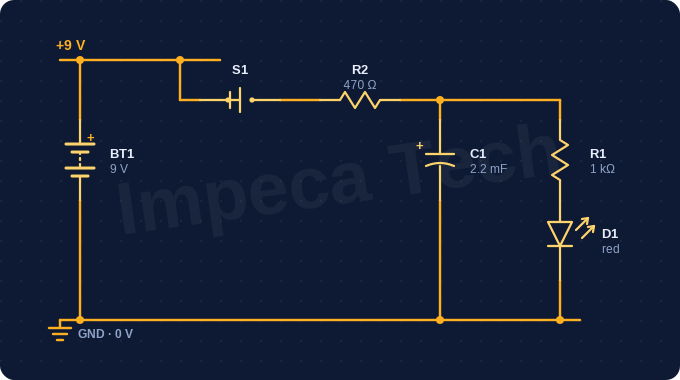
When you release the button the LED does not switch off at once: a 2200 µF capacitor keeps it lit and fades it out gently.
15 min9 V DC
View circuit
-
 08
Adjustable Voltage Divider
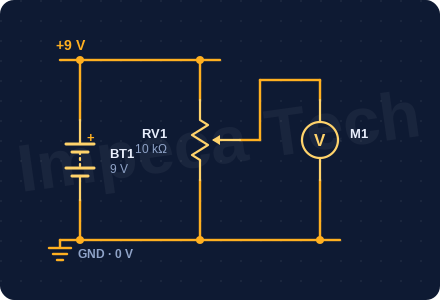
A potentiometer splits the battery’s 9 V so you can pick any voltage between 0 and 9 V, which you read with a multimeter.
10 min9 V DC
View circuit
-
 09
Transistor as a Switch
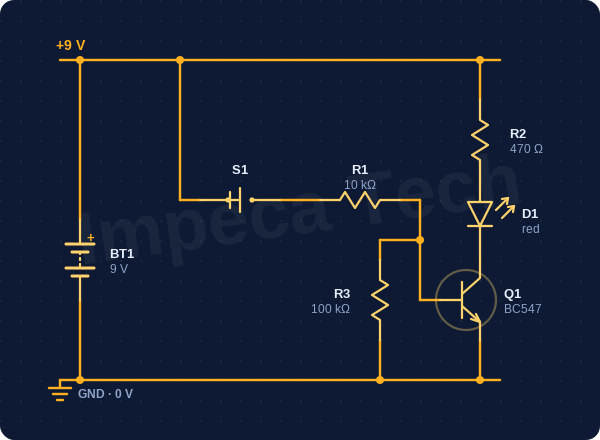
A BC547 transistor works as a controlled switch: a tiny current into its base lights an LED. No code required.
20 min9 V DC
View circuit
-
 11
One-Finger Touch Switch
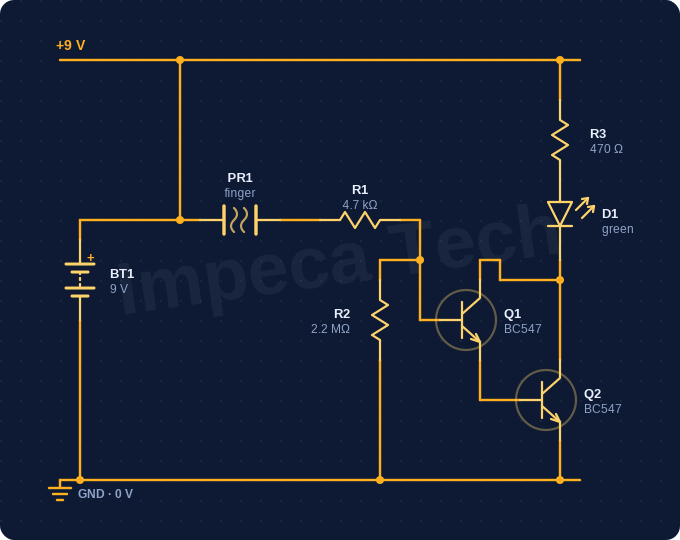
Touch two metal contacts with one finger and an LED lights up. Your skin lets a tiny current through and two transistors wired as a pair multiply it until the LED lights.
15 min9 V DC
View circuit
-
 12
Automatic Night Light (LDR)
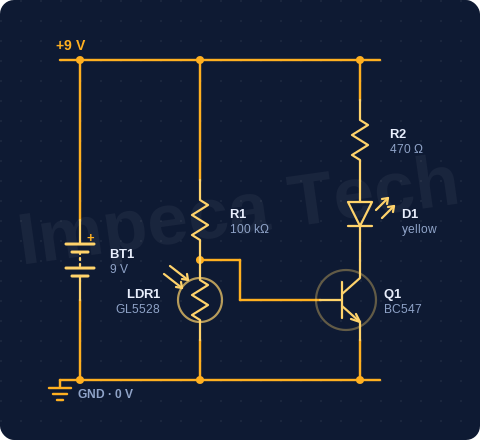
A photoresistor (LDR) and a BC547 transistor turn an LED on when it gets dark. No code or microcontroller involved.
20 min9 V DC
View circuit
-
 16
3-LED Water Level Indicator
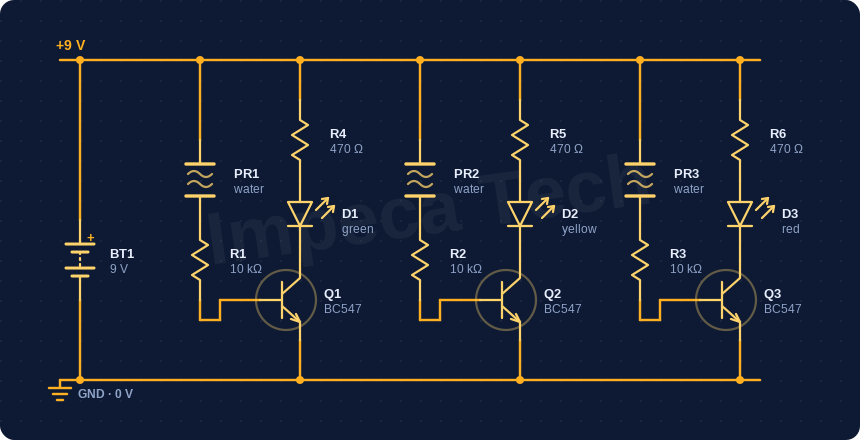
Three LEDs (green, yellow and red) show whether the container is a third full, two thirds full or full. Three probes at different heights, each driving its own transistor.
20 min9 V DC
View circuit
-
 22
Magnetic Door Open Alarm
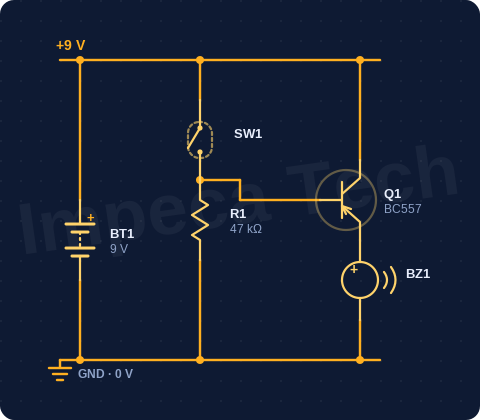
A magnet stuck on the door keeps a reed switch closed; when the door opens the reed opens and a buzzer sounds. It is the simplest door and window alarm.
20 min9 V DC
View circuit
-
 27
Two-Transistor Flip-Flop Blinker
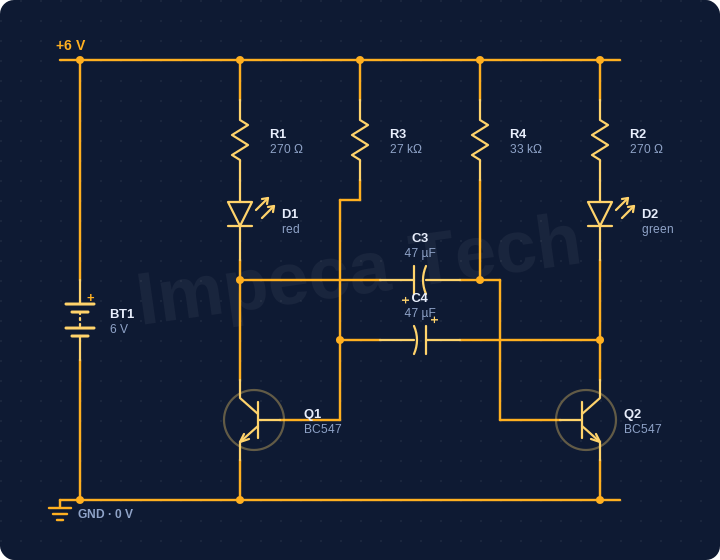
Two LEDs that take turns lighting up non-stop, with no chip and no code: just two transistors and two capacitors passing the baton. It is an astable multivibrator, the most classic blinker in electronics.
25 min6 V DC (4 AA batteries)
View circuit
-
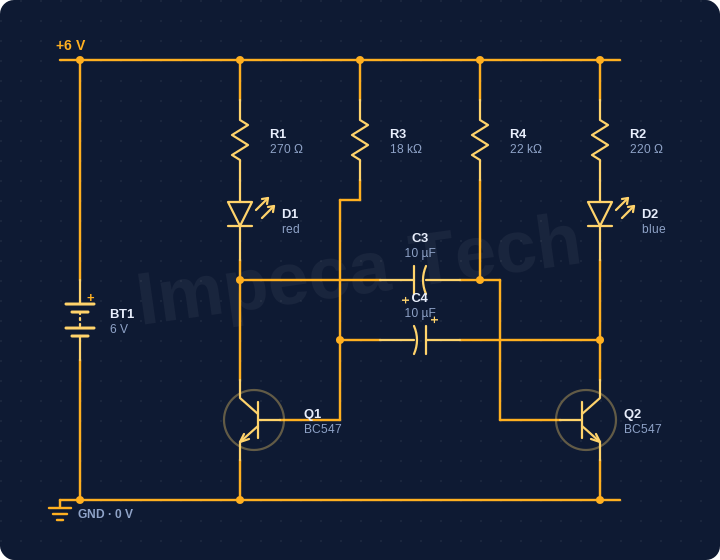 28
Chip-Free Alternating Police Light
A red LED and a blue one that alternate quickly, like a patrol-car beacon, built with just two transistors and two capacitors. It is the same multivibrator as the blinker, but with smaller capacitors.
25 min6 V DC (4 AA batteries)
View circuit
No featured circuit matches your search. Try another word, another category or another tab.
Electricity basics, Ohm’s law, capacitors, diodes, transistors (BC547/2N2222) and passive sensors.
-
 01
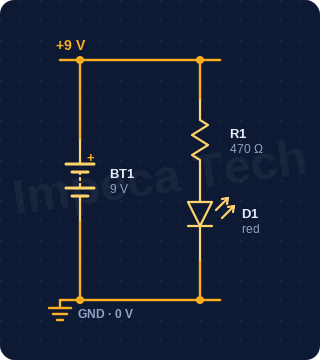
Simple LED Circuit
Light an LED from a 9 V battery with a resistor that protects it. It is the first circuit in electronics and needs no programming at all.
10 min9 V DC
View circuit
-
 02
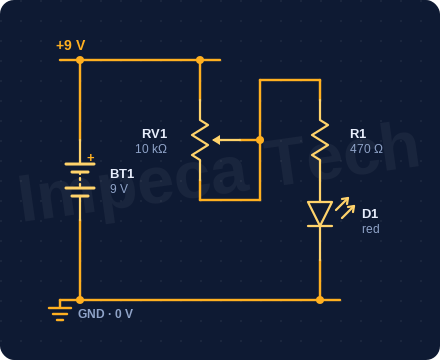
Manual LED Brightness Dimmer
Adjust the brightness of an LED by turning a potentiometer, no code needed. The potentiometer works as a variable resistor.
10 min9 V DC
View circuit
-
 03
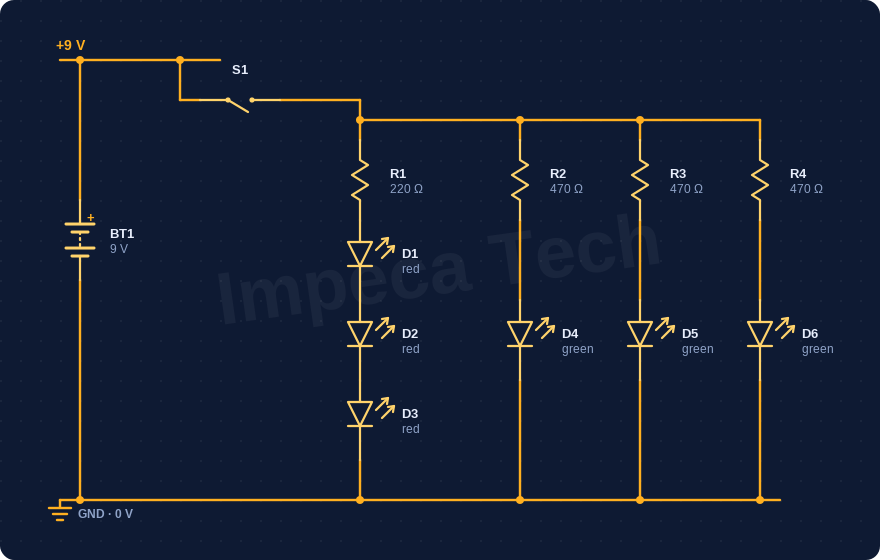
LEDs in Series vs Parallel
Compare two ways of wiring several LEDs: three in series sharing one resistor and three in parallel, each with its own. One switch turns both groups on at once and you see what happens when one LED fails.
20 min9 V DC
View circuit
-
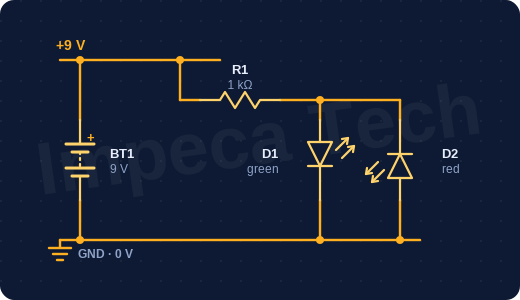 04
Two-LED Polarity Tester
Two LEDs of different colours tell you which way the current arrives: green if the polarity is right, red if it is reversed.
10 min9 V DC
View circuit
-
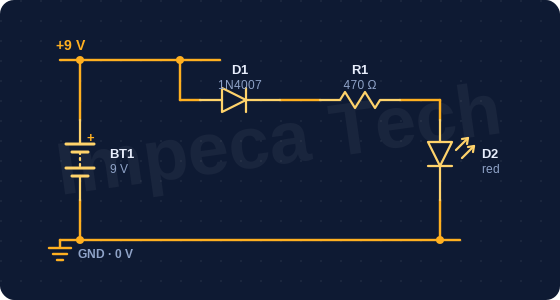 05
Reverse Polarity Protection
A 1N4007 diode in series protects the circuit if you connect the battery the wrong way round: the LED stays off, but nothing gets damaged.
15 min9 V DC
View circuit
-
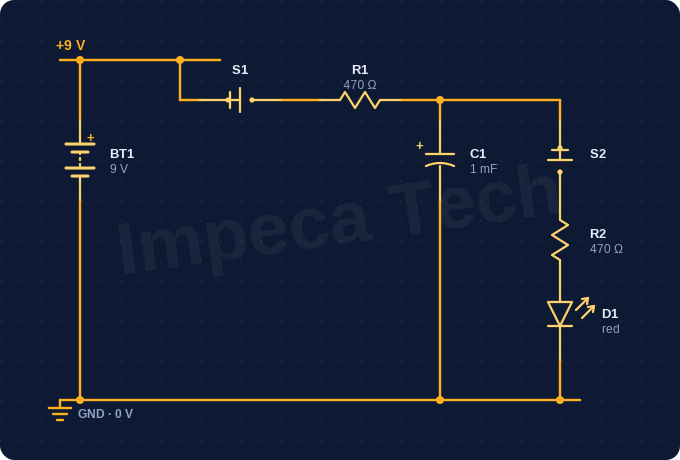 06
Capacitor Charge & Discharge
A 1000 µF capacitor is charged with one pushbutton and discharged through an LED with another: you will see the stored energy being used up gradually.
20 min9 V DC
View circuit
-
07
Smooth LED Fade-Out
When you release the button the LED does not switch off at once: a 2200 µF capacitor keeps it lit and fades it out gently.
15 min9 V DC
View circuit
-
08
Adjustable Voltage Divider
A potentiometer splits the battery’s 9 V so you can pick any voltage between 0 and 9 V, which you read with a multimeter.
10 min9 V DC
View circuit
-
09
Transistor as a Switch
A BC547 transistor works as a controlled switch: a tiny current into its base lights an LED. No code required.
20 min9 V DC
View circuit
-
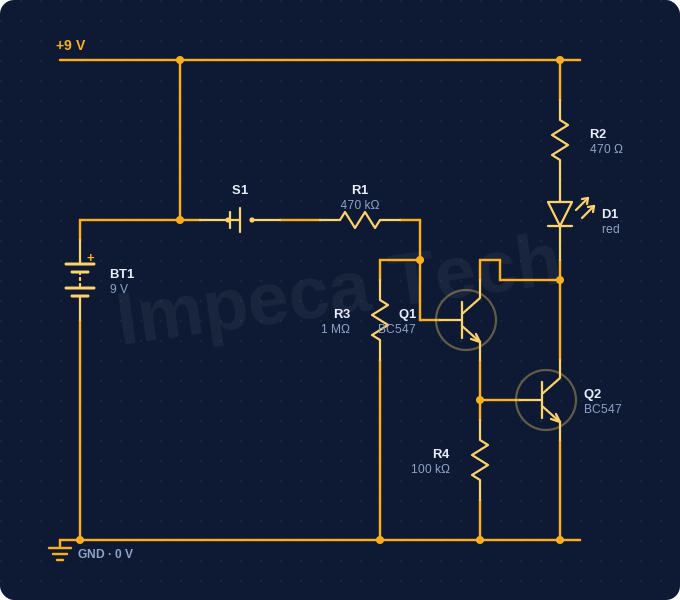 10
Darlington Pair Current Amplifier
Two BC547 transistors chained together (a Darlington pair) multiply the current: a tiny trickle through the button is enough to light an LED.
20 min9 V DC
View circuit
-
11
One-Finger Touch Switch
Touch two metal contacts with one finger and an LED lights up. Your skin lets a tiny current through and two transistors wired as a pair multiply it until the LED lights.
15 min9 V DC
View circuit
-
12
Automatic Night Light (LDR)
A photoresistor (LDR) and a BC547 transistor turn an LED on when it gets dark. No code or microcontroller involved.
20 min9 V DC
View circuit
-
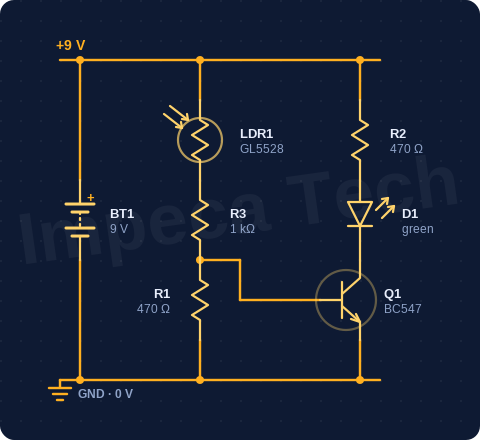 13
Daylight-Activated Switch
The opposite of a night light: the LED lights when there is light and goes off in the dark, using an LDR and a BC547 transistor.
20 min9 V DC
View circuit
-
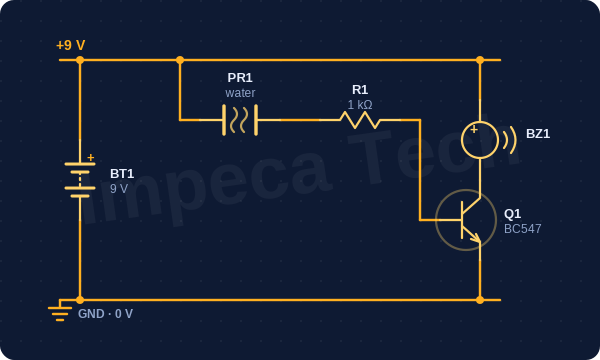 15
Audible Water Level Detector
A buzzer warns you when water rises and touches two bare wires. It tells you a bucket or container is about to fill up.
15 min9 V DC
View circuit
-
16
3-LED Water Level Indicator
Three LEDs (green, yellow and red) show whether the container is a third full, two thirds full or full. Three probes at different heights, each driving its own transistor.
20 min9 V DC
View circuit
-
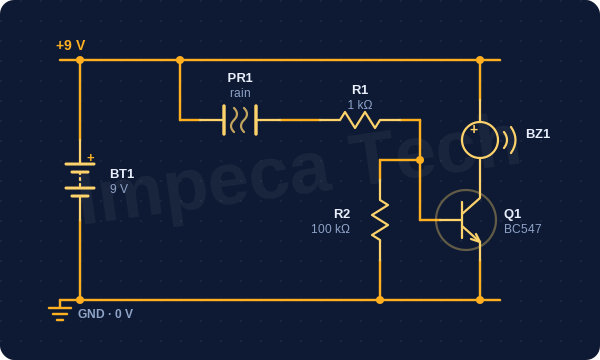 17
Rain Detector Alarm
A buzzer sounds when the first drops fall on a sensor plate. The plate has two separate tracks that the water joins.
15 min9 V DC
View circuit
-
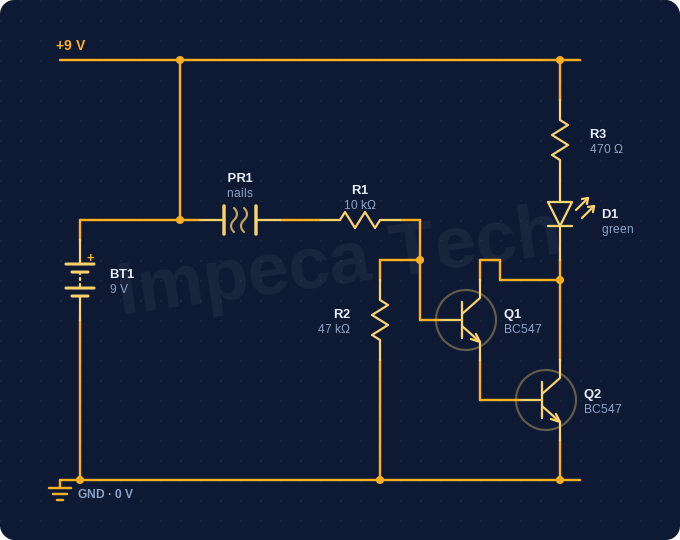 18
Soil Moisture Detector
Two nails pushed into the plant pot light an LED when the soil is damp. A Darlington pair amplifies the tiny current that flows between the nails.
20 min9 V DC
View circuit
-
 19
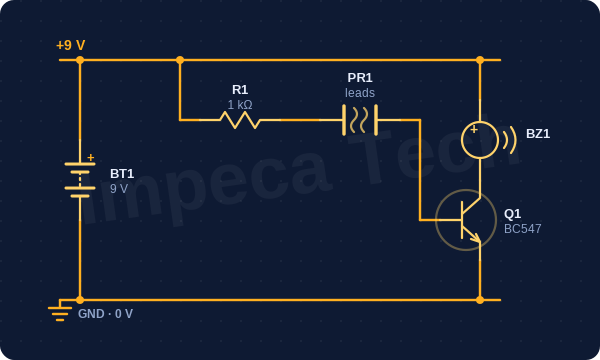
Audible Continuity Tester
A tester that sounds when there is continuity between its two leads. Use it to check wires, fuses, switches and tracks, always with no power on them.
15 min9 V DC
View circuit
-
 20
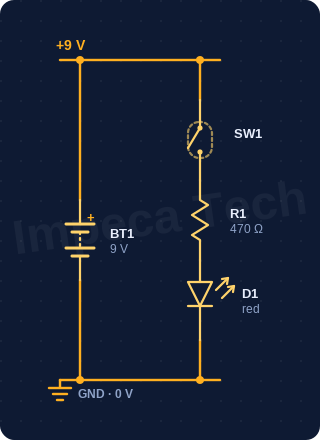
Magnetic Reed Switch Detector
A reed switch, a glass capsule with two metal blades, closes when you bring a magnet near and lights an LED. It detects the magnet without touching it.
10 min9 V DC
View circuit
-
22
Magnetic Door Open Alarm
A magnet stuck on the door keeps a reed switch closed; when the door opens the reed opens and a buzzer sounds. It is the simplest door and window alarm.
20 min9 V DC
View circuit
-
 23
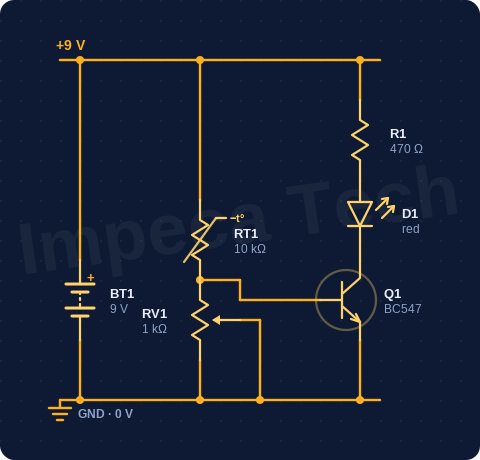
Thermistor Heat Detector
An NTC thermistor senses heat and lights a red LED when the temperature goes above a threshold you set with a potentiometer.
20 min9 V DC
View circuit
-
 24
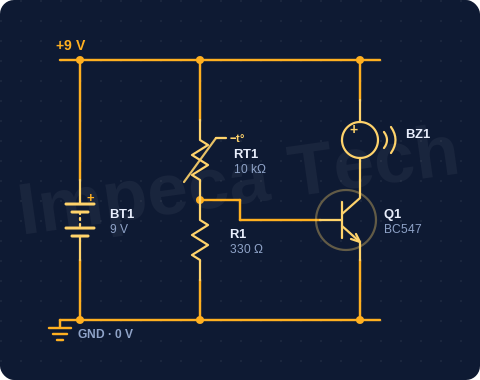
Simple Fire Alarm (NTC)
An NTC thermistor senses very hot air and sounds a buzzer. It is a heat warning for learning, not a certified fire detector.
15 min9 V DC
View circuit
-
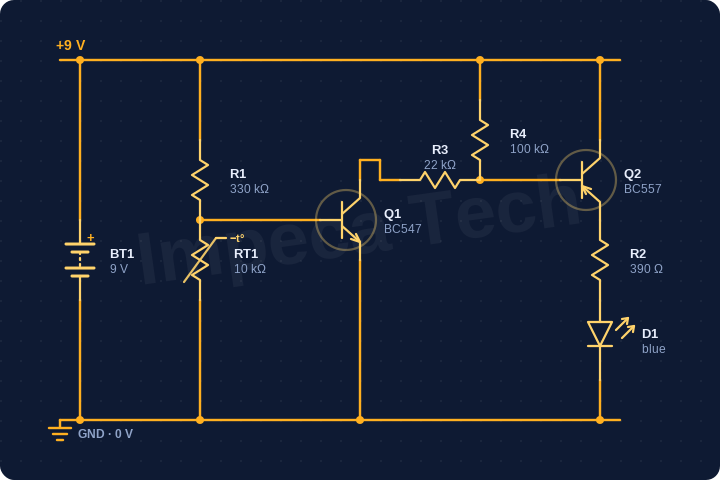 25
Frost / Cold Detector
A blue LED lights when the temperature falls to a few degrees above zero. Two transistors, an NPN and a PNP, work in a chain to turn cold into light.
20 min9 V DC
View circuit
-
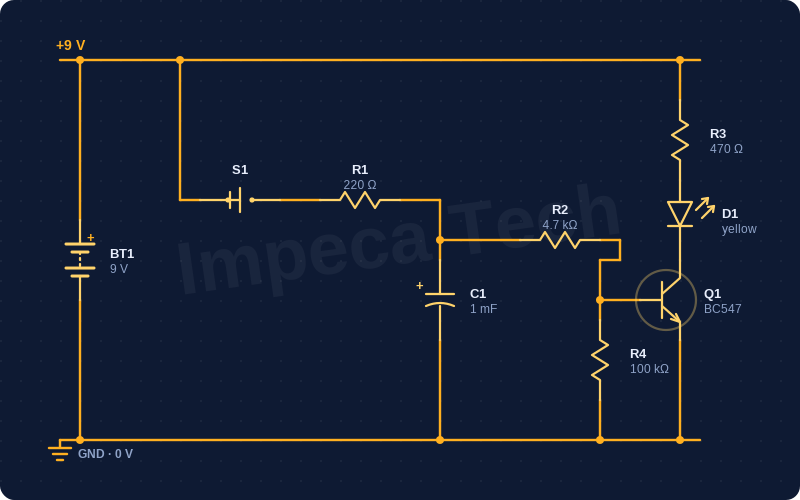 26
Simple Light Timer
Press a button and the LED lights, then fades out by itself, slowly, over about 20 seconds. A capacitor stores the charge and a transistor turns it into light.
20 min9 V DC
View circuit
-
27
Two-Transistor Flip-Flop Blinker
Two LEDs that take turns lighting up non-stop, with no chip and no code: just two transistors and two capacitors passing the baton. It is an astable multivibrator, the most classic blinker in electronics.
25 min6 V DC (4 AA batteries)
View circuit
-
28
Chip-Free Alternating Police Light
A red LED and a blue one that alternate quickly, like a patrol-car beacon, built with just two transistors and two capacitors. It is the same multivibrator as the blinker, but with smaller capacitors.
25 min6 V DC (4 AA batteries)
View circuit
-
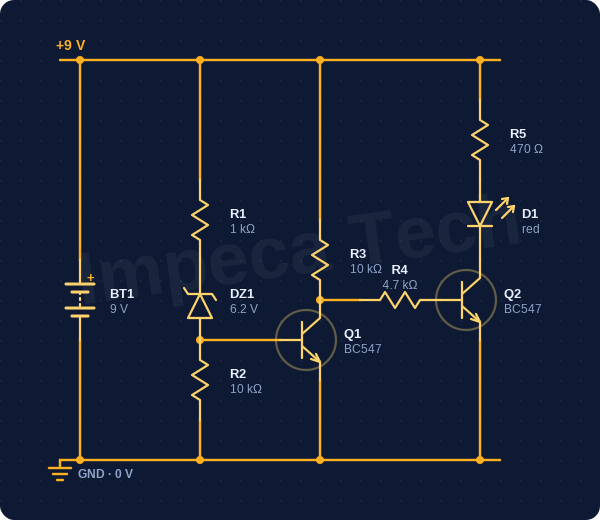 32
Low Battery Indicator (1 LED)
A red LED that lights only when the 9 V battery is almost flat. A Zener diode acts as a voltage “gauge” and two transistors turn it into a warning.
20 min9 V DC
View circuit
-
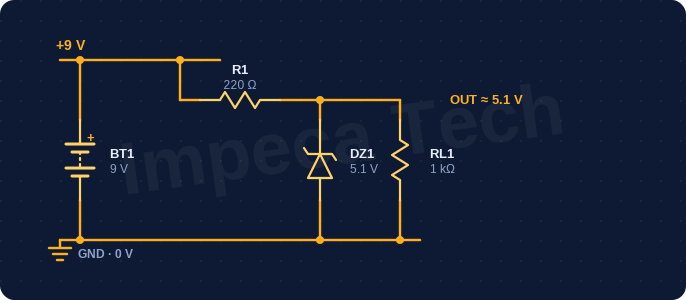 34
Simple Zener Voltage Regulator
A 5.1 V Zener diode and a resistor turn the battery’s 9 V into a steady voltage of about 5 V for a small load.
15 min9 V DC
View circuit
-
 41
Tilt Switch Alarm
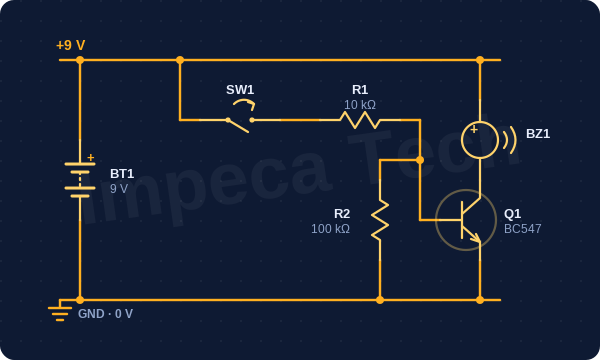
A tilt sensor with a small metal ball closes its contact when tilted and sounds a buzzer. It warns you that someone is moving an object or opening a lid.
15 min9 V DC
View circuit
-
 42
Diode AND Logic Gate
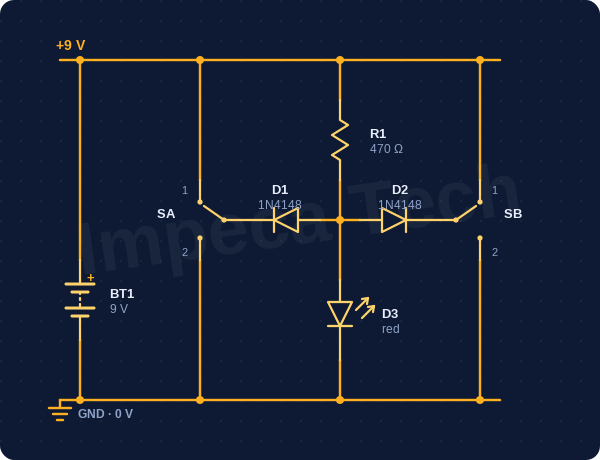
An AND logic gate built from two diodes: the LED lights only when both inputs are 1. Try it with two switches and check its truth table.
20 min9 V DC
View circuit
-
 43
Diode OR Logic Gate
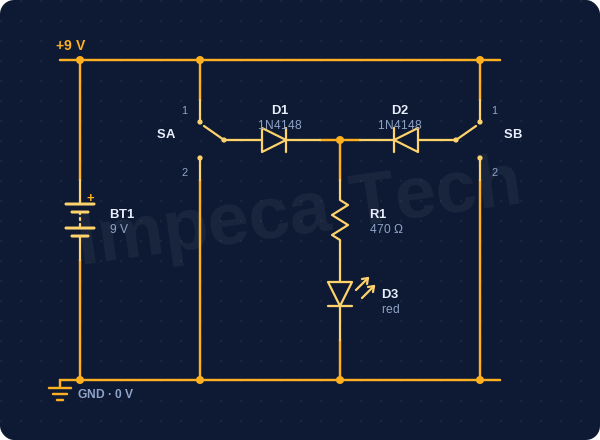
An OR logic gate built from two diodes: the LED lights when at least one of the two inputs is 1. The simplest version of a diode gate.
20 min9 V DC
View circuit
-
 44
Transistor NOT Logic Gate
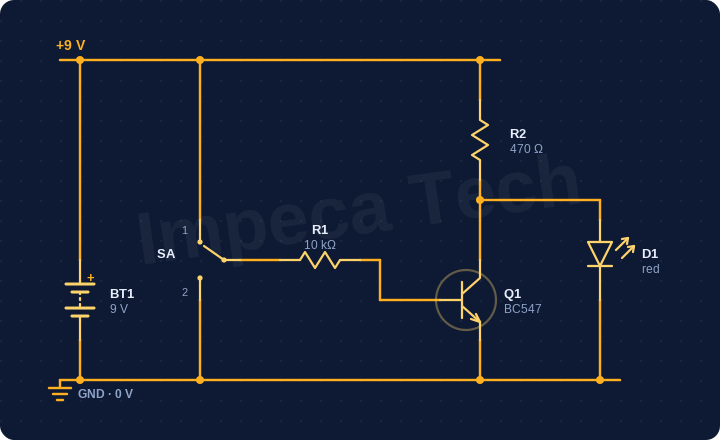
The simplest inverter: a transistor that flips the signal. With the input at 0 the LED lights, with the input at 1 it goes off.
20 min9 V DC
View circuit
-
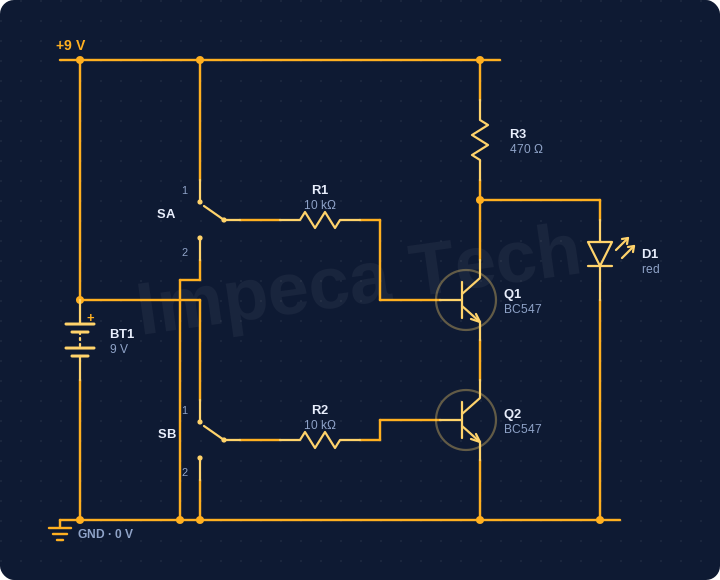 45
Transistor NAND Logic Gate
A NAND gate with two transistors in series: the LED goes off only when both inputs are 1. The NAND is the “universal” gate: any other gate can be built from it.
25 min9 V DC
View circuit
-
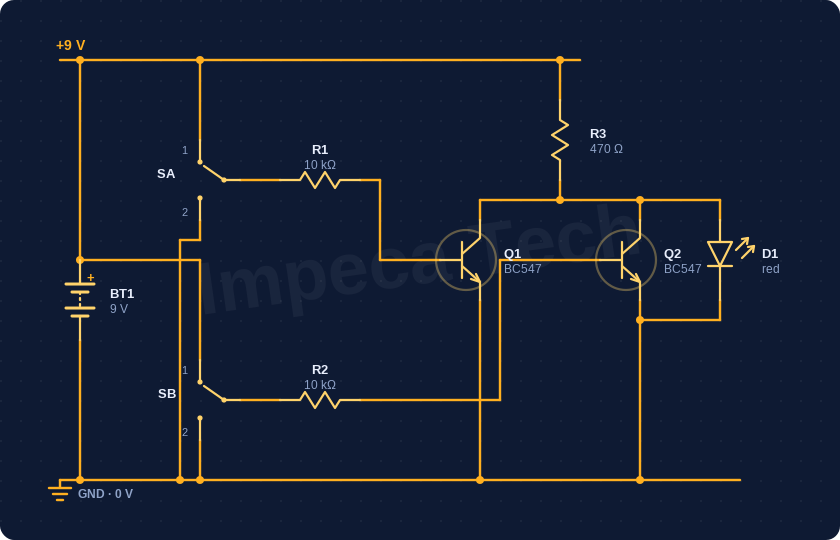 46
Transistor NOR Logic Gate
A NOR gate with two transistors in parallel: the LED lights only when both inputs are 0. It is the inverted OR and, like the NAND, a universal gate.
25 min9 V DC
View circuit
No circuit in this level matches your search. Try another word, another category or another level.
Timers (NE555), op-amps (LM358/LM741), linear regulators (LM317/7805), audio (LM386) and MOSFETs.
We are preparing the circuits for this level. In the meantime you can start with the Beginner ones.
Hard-wired digital logic (CMOS 4000 / TTL 74HC), counters, 7-segment displays, analogue autonomous robotics and complex systems.
We are preparing the circuits for this level. In the meantime you can start with the Beginner ones.
Want to automate these circuits with code?
Learn to program sensors and exact schedules with Arduino in our e-book “Arduino from Scratch”.